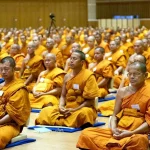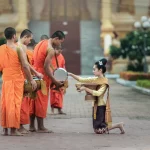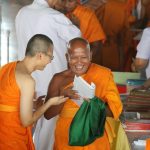
The Lord Buddha offered us a teaching on the accumulation of merit, concerning the matter of respect.
The Lord Buddha pointed out that reverence is a source of great merit, for wherever reverence arises within a person, it is a sign that such a person possesses wisdom and has employed that wisdom to its fullest. For reverence is nothing other than a deep recognition of the genuine goodness and virtue that truly exist — within persons, within things, and within the events of life.
As an example of reverence toward persons: it is the deep recognition and heartfelt appreciation of the virtue of the Blessed One, the virtue of the Dhamma, and the virtue of the Sangha. Likewise, it is the recognition of the grace and goodness of one’s own father and mother.
Even children of discerning mind — those who have been well-guided and nurtured by their parents and teachers — come to possess such reverence. They hold a genuine recognition of the goodness of their parents and teachers. And when one truly recognizes and is moved by the virtue and goodness of another, one is compelled, as though naturally and of its own accord, to aspire to embody that same goodness oneself. It is precisely in this way that reverence becomes a path to great merit.
Fenruary 11th, 2014
Notes on the translation:
- “ความเคารพ” — reverence — corresponds to the Pāli gārava, one of the seven qualities praised by the Buddha as conducive to the non-decline of the Dhamma and the spiritual community, enumerated in the Satta Aparihāniya Dhammā of the Dīgha Nikāya.
- “บุญใหญ่” — great merit — reflects the Pāli mahāpuñña, the abundant wholesome kamma generated by actions rooted in wisdom, faith, and sincere appreciation of virtue, as opposed to merit arising from mere ritual or habit.
- “คุณความดีที่มีอยู่จริง” — genuine goodness that truly exists — subtly affirms the Buddhist epistemological position that virtue is not merely conventional or subjective, but an objective quality discernible by the trained and wise mind (paññācakkhu: the eye of wisdom).
- “คุณของพระสัมมาสัมพุทธเจ้า คุณของพระธรรม คุณของพระสงฆ์” refers to the Iti pi so recollection — the threefold contemplation of the virtues of the Buddha, Dhamma, and Sangha (Buddhānussati, Dhammānussati, Saṅghānussati) — among the most foundational devotional and meditative practices in Theravāda Buddhism.
- “บังคับเขาโดยอัตโนมัติ” — compelling one as though automatically — evokes the natural moral momentum (saṅkhāra) generated by genuine appreciation of virtue: the recognition of goodness in another spontaneously kindles the aspiration to embody it, a process akin to kalyāṇamittatā (noble friendship) functioning as a mirror for one’s own potential.
- “พระคุณของคุณพ่อคุณแม่” — the grace of one’s parents — reflects the Buddha’s profound teaching in the Kataññu Sutta that parents are worthy of the highest gratitude, being compared to Brahmā dwelling within the home, for the immeasurable gift of life, nourishment, and moral formation they bestow.